
Aug 12, 2026
SEO vs GEO vs AEO: How Dubai Brands Can Get Found on Google, ChatGPT & AI Search in 2026
SEO vs GEO vs AEO explained: how Dubai & UAE brands can rank on Google, get cited by ChatGPT, and win AI search visibility in 2026.
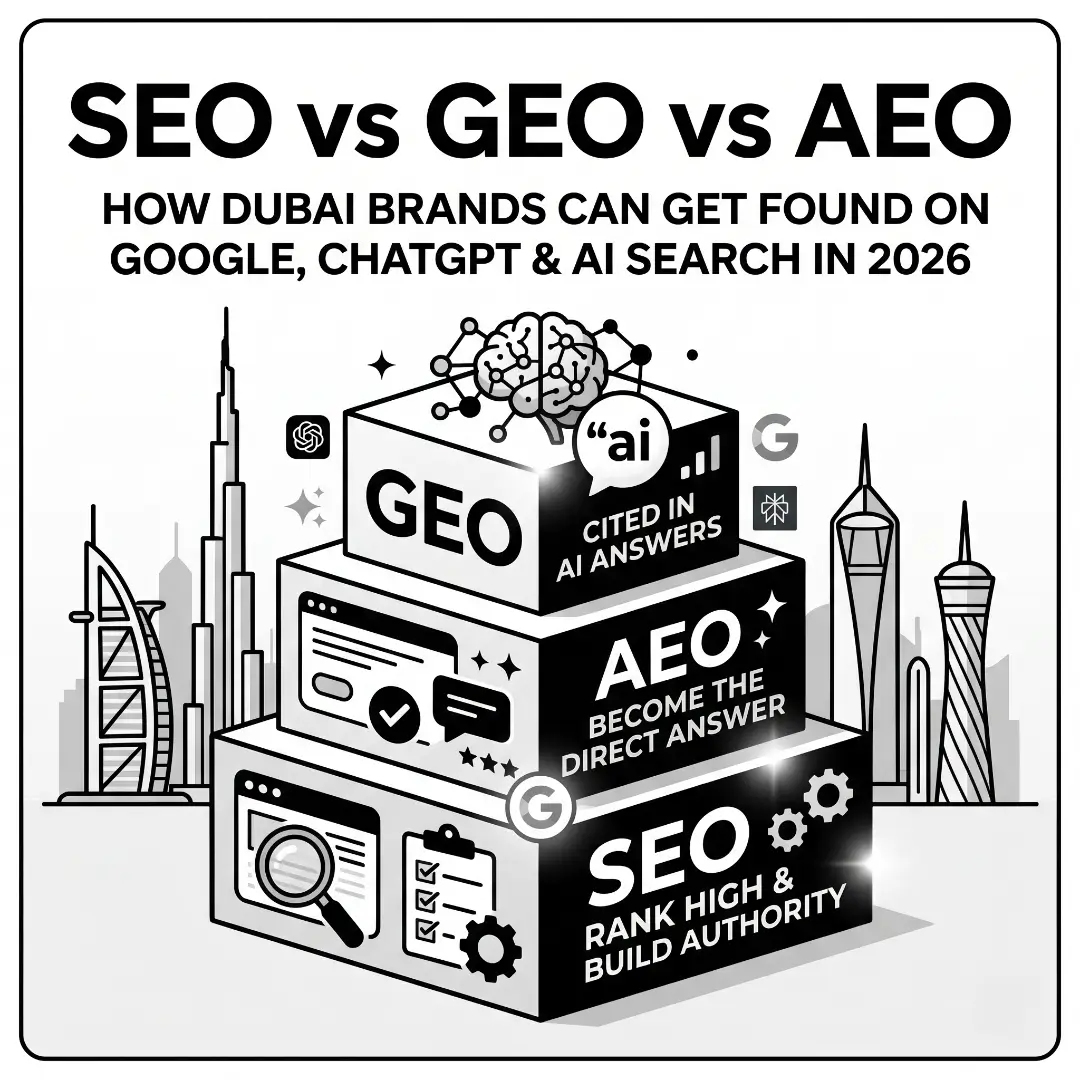
Search in the UAE doesn't look like it did even two years ago. A shopper in Dubai Marina researching "best villa interior designers in Dubai" might now get their answer from a ChatGPT summary, a Google AI Overview, or a Perplexity result - with zero clicks to any website. For brands, that's a fundamental shift: ranking #1 on Google is no longer enough. You now need to show up inside the answer itself.
That's where three disciplines come in - SEO, GEO, and AEO. They overlap, but they're not the same thing, and confusing them is the fastest way to waste marketing budget in 2026. This guide breaks down what each one means, how AI search actually works, and exactly what Dubai and UAE businesses need to do to get found on Google, ChatGPT, and every AI engine in between.
SEO vs GEO vs AEO: What's the Difference?
The simplest way to think about it: SEO gets you into the race, AEO gets you the podium, GEO gets you quoted by the commentator.
They're not competing strategies - they're layers. A page with strong SEO fundamentals (fast, crawlable, authoritative) is far more likely to also perform well in AEO and GEO, because AI systems still rely heavily on traditional search infrastructure to find and evaluate content in the first place.
What Is GEO (Generative Engine Optimization)?
GEO is the practice of optimizing content so that generative AI tools - ChatGPT, Google's Gemini, Perplexity, Claude, Copilot - are more likely to reference, quote, or recommend your brand when answering a user's question.
Unlike traditional SEO, GEO isn't about ranking a URL. It's about becoming a trusted data point that a language model draws on when constructing an answer. That means AI systems care less about your page's meta description and more about:
- Clarity and structure - Is the information easy to extract? Clear headings, direct answers, and well-organized facts get cited more than dense, marketing-heavy paragraphs.
- Entity consistency - Does your business name, address, services, and claims match everywhere online (your site, Google Business Profile, directories, LinkedIn)? AI models cross-reference for consistency before trusting a source.
- Third-party validation - Are you mentioned on other credible sites, review platforms, and news outlets? LLMs weigh how often and how consistently your brand is described across the web, not just what you say about yourself.
- Freshness and specificity - Vague claims ("we're the best agency in Dubai") get ignored. Specific, factual statements ("we've delivered 120+ e-commerce projects for UAE retail brands since 2019") get pulled into answers.
In short: GEO is reputation management and structured content strategy working together, aimed at machines instead of just human readers.
How Does Google AI Search Work?
Google's AI Overviews (and the broader AI Mode rolling out across Search) don't work like the traditional "10 blue links" model. Here's the simplified flow:
- Retrieval - Google's systems pull from its existing index (the same crawled, ranked web pages used for classic search) to gather candidate sources for the query.
- Synthesis - A language model reads the top-ranking, most relevant pages and generates a conversational summary, blending information from multiple sources rather than sending the user to just one.
- Citation - Google typically links out to a handful of the source pages it drew from, usually shown as small citation cards above or beside the AI answer.
- Ranking signals still apply - because AI Overviews are built from Google's index, pages still need solid technical SEO, topical relevance, and authority even to be considered a source. AI doesn't replace SEO - it sits on top of it.
The practical takeaway: if your page isn't already indexable, fast, and topically authoritative, it's unlikely to be pulled into an AI Overview at all. Good SEO is the entry ticket. Good GEO is what gets you actually quoted once you're in the room.
How to Optimize Your Website for AI Search
Here's a working checklist Dubai brands can apply today:
- Answer questions directly, near the top of the page. AI systems extract concise, self-contained answers. Open each key section with a 2–3 sentence direct answer before expanding into detail.
- Use clear, semantic structure. Proper H1/H2/H3 hierarchy, short paragraphs, bullet points, and tables (like the one above) are far easier for LLMs to parse and extract than long unbroken text blocks.
- Add structured data (schema markup). FAQ schema, Organization schema, LocalBusiness schema, and Product schema provide AI crawlers with machine-readable facts about who you are, what you offer, and where you operate, reducing ambiguity.
- Build topical depth, not just single pages. A pillar-and-cluster content structure (like this article and its supporting posts) signals topical authority. AI models favor sources that clearly specialize in a subject over sites with one thin, isolated page.
- Earn mentions beyond your own website. Since GEO weighs third-party validation, invest in digital PR, guest contributions, review platforms (Google Reviews, Trustpilot), and industry directories relevant to the UAE market.
- Keep facts current and consistent. Update pricing, service areas, and business details regularly. Inconsistent or outdated facts across your site and citations reduce AI trust in your content.
- Make sure crawlers can actually reach you. Check robots.txt, ensure key pages aren't blocked, submit an updated XML sitemap, and confirm AI crawlers (GPTBot, Google-Extended, PerplexityBot) aren't disallowed if you want to be eligible for citation.
How to Get Your Business Mentioned in ChatGPT
ChatGPT (and tools like it) don't crawl the live web the same way Google does - but increasingly, models with browsing/search capability pull from real-time web data, training data, and partner data sources (like Bing's index) to answer questions. To increase your odds of being mentioned:
- Be genuinely well-documented online. ChatGPT's browsing-enabled answers rely on indexed web content - so everything in the "optimize for AI search" checklist above directly boosts ChatGPT's visibility, too.
- Get listed and reviewed on platforms LLMs trust. Google Business Profile, Bing Places, industry-specific directories, and review sites are commonly pulled into AI answers about local businesses.
- Publish original data and expertise. Case studies, original statistics, and clearly credited expert commentary are the kinds of content that generative models prefer to cite rather than generic marketing copy.
- Maintain a clean, factual, Wikipedia-adjacent footprint where possible - press coverage, association memberships, and credible third-party bios all strengthen the confidence with which an AI model can describe your business.
- Avoid keyword-stuffed, promotional language. Models are trained to discount overtly salesy phrasing in favor of neutral, factual descriptions - write like you're briefing a journalist, not writing an ad.
How Can Dubai Businesses Rank in ChatGPT & AI Search?
Ranking in AI search as a Dubai-based business comes with a local layer on top of the fundamentals above:
- Localize your entity signals. Make sure your Dubai/UAE address, service areas (e.g., "Dubai Marina," "Business Bay," "Abu Dhabi"), and trade license details are consistent across your website, Google Business Profile, and UAE business directories (like Yellow Pages UAE, Dubai Chamber listings, etc.).
- Get cited in regional publications. Mentions in outlets like Gulf News, Khaleej Times, Arabian Business, or Gulf Business carry strong local authority signals that AI models pick up on when answering UAE-specific queries.
- Publish UAE-specific content, not generic global content. An article titled "Best CRM Software 2026" is competing globally. "Best CRM Software for Dubai SMEs in 2026" is targeting a specific, winnable, and AI-answerable niche.
- Consider bilingual content. Arabic-language content optimized for AI search opens visibility in a completely separate query space that most competitors are still ignoring.
- Claim and optimize your Google Business Profile fully - categories, services, photos, and Q&A sections all feed both Google's local AI answers and broader AI training/browsing data.
How Can My UAE Business Appear in AI Answers?
Bringing it all together, here's the practical sequence:
- Audit your current visibility: search your brand name and key services in ChatGPT, Gemini, and Google AI Overviews to see what's being said about you (if anything).
- Fix entity consistency - align your name, address, phone number (NAP), and service descriptions across all online channels.
- Build a pillar-and-cluster content hub around your core services, written to answer real customer questions directly (this article is an example of that structure).
- Add schema markup across your site - Organization, LocalBusiness, FAQ, and Article schema at minimum.
- Earn third-party mentions through PR, reviews, directories, and partnerships.
- Track AI citations over time, not just Google rankings - treat "did AI mention us" as a KPI alongside traditional keyword rank tracking.
The Bottom Line
SEO, AEO, and GEO aren't three separate strategies competing for budget - they're three layers of the same discipline, built on top of each other. SEO gets your content found and indexed. AEO shapes it so it can be pulled into direct-answer boxes. GEO ensures that when a generative AI model is deciding whom to trust and whom to quote, it reaches for your Dubai business.
The brands that treat 2026 as "just another SEO year" will watch competitors get quoted in ChatGPT and Google AI Overviews, even though those competitors don't show up in the sources. The brands that adapt now - with structured, consistent, genuinely useful content - will own the AI answer layer for years to come.
Tell us about your business, and we’ll create a custom plan to grow your traffic, leads, and predictable revenue.


Project or Idea, big or small, It matters.
We'd love to hear that.
We'd love to hear that.
better get


